
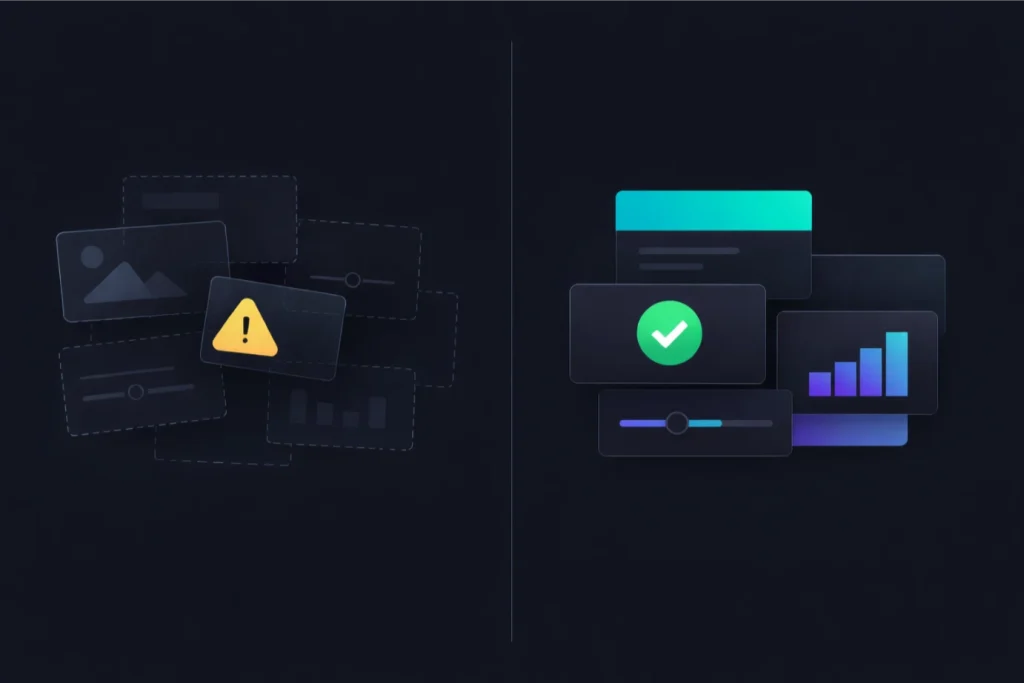
Somewhere along the way, MVP became shorthand for “let’s just ship something.”
Not something thoughtful or usable, just something.
The phrase Minimum Viable Product was popularised by Eric Ries in The Lean Startup as a way to test assumptions with the least amount of effort necessary to start learning. The intent was disciplined learning. What many teams hear instead is permission to cut corners.
Those are not the same thing.
An MVP is not the smallest product you can build. It is the smallest product that can create real learning. And real learning requires effort.
The Word We Ignore: “Viable”
“Minimum” gets all the attention.
“Viable” does the heavy lifting.
Viable means:
- A real user can complete a meaningful task
- The experience is coherent, not confusing
- The product delivers on one clear promise
- The feedback you collect is based on actual usage, not politeness
If users abandon it in 30 seconds because it feels broken, you did not test your hypothesis. You tested their patience.
That is not lean. That is a waste.
What a Good MVP Actually Requires
Reducing scope is not the same as reducing rigour.
A thoughtful MVP still demands:
1. Sharp Problem Definition
You must be precise about what you are testing.
Not “Will people use this?”
But “Will operations managers automate this weekly report if it saves them 30 minutes?”
Clarity before code.
2. Intentional Scope
You remove features that distract from the core hypothesis.
You do not remove the elements that make the core usable.
There is a difference between:
Cutting features
Cutting quality
The first is discipline. The second is debt.
3. Real Experience Design
Even a simple product needs a coherent flow.
If the onboarding is unclear or the interface contradicts itself, you are testing confusion, not demand.
Early design debt compounds. It slows iteration later, when speed actually matters.
4. Measurement That Matches the Hypothesis
If your hypothesis is about behaviour, measure behaviour.
If it is about willingness to pay, test this.
An MVP without defined learning goals is just a partial product.
Why “Minimal Effort” Backfires
When teams equate MVP with minimal effort, three things happen.
1. They Collect the Wrong Signals
Users say “interesting” but never return. Or they drop off early because friction hides value.
The team interprets this as a lack of demand, when the real issue is poor execution.
2. They Burn Trust
Early adopters are generous, but not infinitely patient.
If your product feels careless, users assume the company is careless.
That impression is difficult to reverse.
3. They Create Design Debt
Rushed architecture, inconsistent UX, unclear data models.
What felt fast in month one becomes expensive in month six.
Speed without structure slows you later.
What “Minimum” Should Actually Mean
Minimum should mean:
- The smallest surface area required to validate a clear assumption
- The fewest moving parts necessary to deliver one meaningful outcome
- The narrowest scope that still feels complete
It does not mean:
- No onboarding
- No polish
- No instrumentation
- No thinking
The discipline of MVP is restraint, not laziness.
A Practical Test
Before you ship your MVP, ask:
- Can a new user understand what this does within two minutes?
- Can they complete the core action without guidance?
- If they succeed, will we learn something actionable?
- If they fail, will we know why?
If the answer to any of these is no, you have reduced effort. You have not built an MVP.
The Real Trade-Off
MVP is about reducing risk, not reducing responsibility.
You are trading breadth for depth, not care for speed.
When done well, an MVP is focused, intentional, and surprisingly rigorous. It is smaller than the final product, but not smaller in thinking.
Minimal scope.
Serious effort.
That is the difference.